The Hidden Dangers of Trailer Wheel Neglect
On July 28, 2026, a harrowing incident on Route 41 served as a stark reminder of what can happen when trailer maintenance is overlooked. A wheel detached from a moving trailer, striking a bystander and causing critical injuries. This is not an isolated mechanical fluke; wheel detachment is almost always a preventable result of neglected maintenance. Whether you are hauling a luxury RV, a boat, or a simple utility trailer for work, the security of your wheel assembly is the most critical factor in road safety.
Trailer tires and wheels operate under significantly different stresses than those on your tow vehicle. They often sit idle for months, suffering from dry rot, and then are suddenly expected to carry thousands of pounds at highway speeds. Understanding the mechanics of trailer tire maintenance is about more than just checking the tread; it is about ensuring that the hub, the bearings, and the lug nuts function as a single, secure unit. In this guide, we will break down the precise steps needed to ensure your wheels stay exactly where they belong: attached to your axle.
The Primary Culprit: Lug Nut Torque and Vibration
The most common cause of wheel detachment is improper lug nut torque. Unlike passenger vehicles, trailers are subject to intense vibration because they often lack the sophisticated suspension systems found in cars. This vibration can slowly back off a lug nut that wasn’t torqued to the correct specification. Over time, the remaining nuts take on the extra load, eventually shearing off or widening the bolt holes until the wheel literally wobbles off the hub.
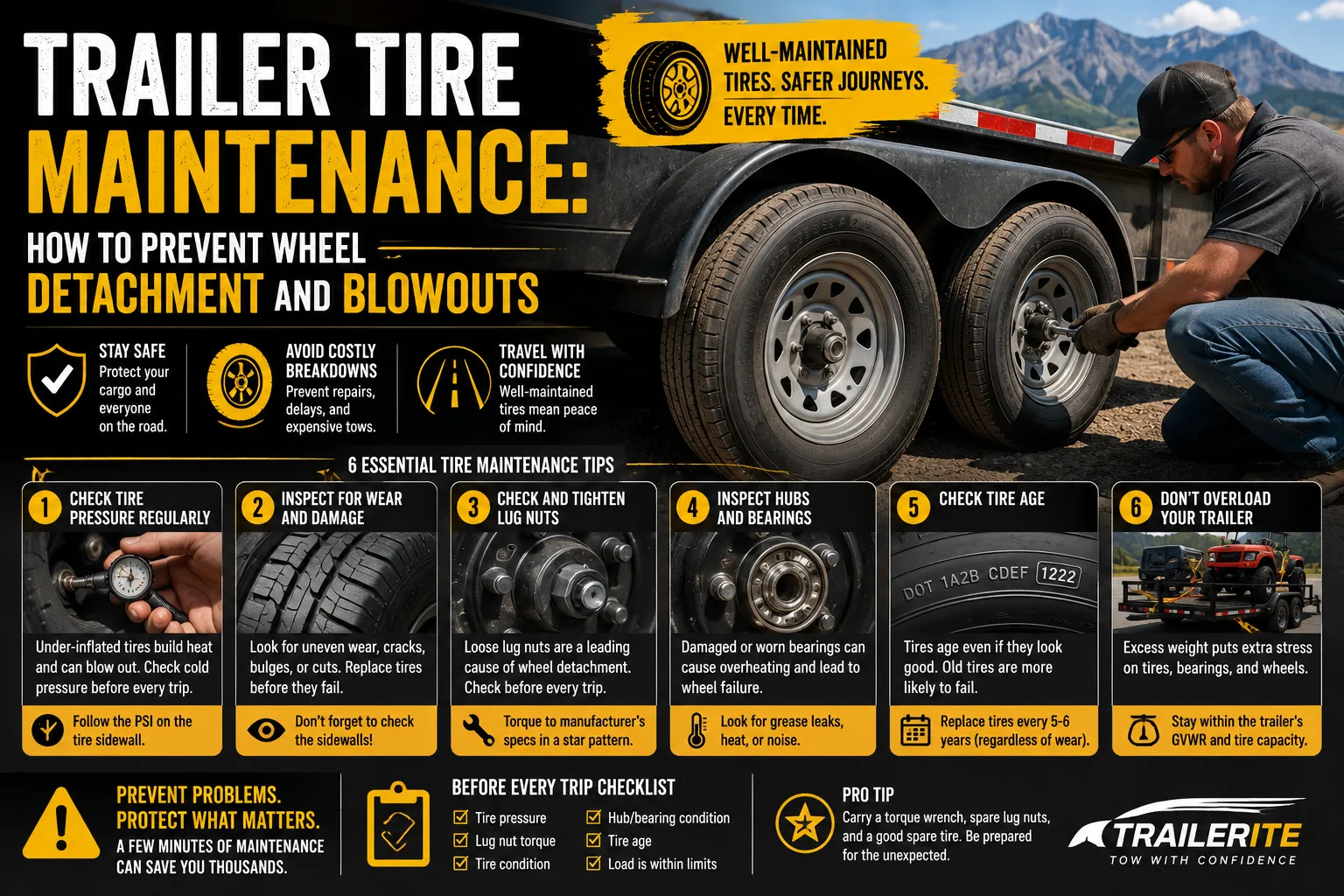
To prevent this, you must use a calibrated torque wrench. Never rely on a standard tire iron or an impact wrench alone, as these can easily under-tighten or over-stretch the studs. Most trailer manufacturers recommend a specific torque sequence—usually a star pattern—to ensure even pressure across the mounting surface. If you have recently changed a tire or have a new trailer, you should check the torque at 10, 25, and 50 miles of travel. The metal-to-metal contact between the wheel and the hub needs time to ‘seat,’ and these initial checks are when you are most likely to find a loose nut.
For more detailed information on the hardware involved in trailer security, you may want to review our Trailer Maintenance Checklist, which covers the essential inspection points for every trip.
Understanding Trailer Tire Pressure and Heat Management
Tire pressure is the lifeblood of trailer safety. Under-inflated tires are the leading cause of blowouts because they allow the sidewalls to flex excessively. This friction generates heat, and heat is the primary enemy of rubber. When a trailer tire gets too hot, the internal structure begins to delaminate, leading to a sudden and violent failure at highway speeds.
Always check your tire pressure when the tires are ‘cold,’ meaning they haven’t been driven on for at least three hours. Trailer tires (ST or ‘Special Trailer’ tires) should almost always be inflated to the maximum PSI listed on the sidewall. This is a common point of confusion for many owners who are used to passenger car tires, where the recommended PSI is usually lower than the max. On a trailer, the load-carrying capacity of the tire is directly tied to its pressure; if you are running at 10 PSI under the max, you are significantly reducing the amount of weight that tire can safely support.
Load Range and Speed Ratings
Not all trailer tires are created equal. You must ensure your tires are rated for the weight of your fully loaded trailer. Check the Load Range (usually a letter from C to F) and ensure it matches or exceeds the requirements of your trailer’s Gross Vehicle Weight Rating (GVWR). Furthermore, many older ST tires were only rated for 65 mph. If you are towing on modern interstates where speeds reach 70 or 75 mph, you must ensure your tires have an ‘L’ or ‘M’ speed rating. Using a tire beyond its speed or load capacity is a recipe for a blowout, regardless of how new the tread looks.
The Hub of the Matter: Wheel Bearing Maintenance
If the lug nuts keep the wheel on the hub, the bearings keep the hub on the axle. A seized wheel bearing is a catastrophic failure that can weld the hub to the spindle or, in extreme cases, melt the entire assembly, allowing the wheel and hub to fly off as a single unit. This is often what happens when motorists report seeing a wheel ‘break off’ with the brake drum still attached.
Maintenance for bearings should be performed annually or every 10,000 miles. This involves removing the hub, cleaning the old grease, inspecting the bearings for ‘pitting’ or discoloration (which indicates overheating), and repacking them with high-quality marine-grade grease. If your trailer has ‘EZ Lube’ or similar grease zerks on the end of the axle, these are excellent for mid-season touch-ups, but they do not replace a full manual repack. In fact, over-greasing through a zerk can sometimes blow out the rear seal, getting grease on your brake shoes and compromising your stopping power.
Proper weight distribution also plays a role in how much stress is placed on these bearings. You can learn how to balance your load correctly in our guide to Trailer Towing and Weight Calculations.
Comparison of Trailer Tire Load Ranges
Choosing the right tire is essential for safety. The following table illustrates the common load ranges for 15-inch trailer tires, which are the standard for many mid-sized utility and RV units.
| Load Range | Ply Rating | Max Pressure (PSI) | Typical Capacity (Lbs per Tire) |
|---|---|---|---|
| C | 6-Ply | 50 PSI | 1,820 – 2,150 |
| D | 8-Ply | 65 PSI | 2,150 – 2,540 |
| E | 10-Ply | 80 PSI | 2,830 – 3,420 |
| F | 12-Ply | 95 PSI | 3,960+ |
The Silent Killer: Tire Age and UV Degradation
One of the most dangerous mistakes a trailer owner can make is assuming that plenty of tread means a tire is safe. Most trailer tires will ‘age out’ long before they ‘wear out.’ Because trailers often sit parked in the sun, UV rays and ozone penetrate the rubber, breaking down the chemical bonds that keep it flexible. This leads to ‘dry rot’—tiny cracks in the sidewall or between the tread blocks.
Industry standards from organizations like the NHTSA suggest that trailer tires should be replaced every 3 to 5 years, regardless of tread depth. To find the age of your tire, look for the DOT code on the sidewall. The last four digits represent the week and year of manufacture. For example, ‘1226’ means the tire was made in the 12th week of 2026. If your tires are more than five years old, the risk of internal belt separation increases exponentially, especially during long summer hauls.
Essential Pre-Trip Safety Checklist
To avoid becoming a statistic like the incident on Route 41, incorporate these five checks into your routine every time you hitch up:
- Check Cold PSI: Ensure every tire is at the maximum pressure listed on the sidewall.
- Torque the Lugs: Use a torque wrench to verify all lug nuts are tight to the manufacturer’s spec (usually 90-120 ft-lbs for most trailers).
- The ‘Hand Feel’ Test: After 20 minutes of driving, safely pull over and feel the wheel hubs (carefully!). They should be warm, but never too hot to touch. A burning hot hub indicates a bearing failure or a dragging brake.
- Inspect for Cracking: Look closely at the sidewalls and between the tread for any signs of dry rot or ‘bubbling.’
- Check the Spare: A spare tire is useless if it is flat or dry-rotted. Ensure it is maintained with the same rigor as the primary tires.
For high-quality replacement parts and technical specifications, primary manufacturers like Dexter Axle provide comprehensive manuals that can help you identify the specific bearing and seal sizes for your equipment. Taking these proactive steps ensures that your trailer tire maintenance routine is a solid defense against highway disasters.
Conclusion: A Culture of Safety
Maintaining a trailer requires a different mindset than maintaining a car. Because trailers lack the sophisticated onboard diagnostics that warn us of low tire pressure or mechanical strain, the responsibility falls entirely on the owner. By understanding the critical relationship between lug nut torque, bearing lubrication, and tire inflation, you can significantly reduce the risk of a catastrophic wheel failure. Road safety is a shared responsibility, and it starts with the hardware connecting your trailer to the pavement.
Frequently Asked Questions
How often should I grease my trailer wheel bearings?
Trailer wheel bearings should be fully inspected and repacked with grease at least once a year or every 10,000 miles, whichever comes first. If you have a boat trailer that is submerged in water, this maintenance should be done more frequently.
Why do my trailer tires keep blowing out?
The most common causes of trailer tire blowouts are under-inflation, overloading, exceeding the tire’s speed rating, and heat buildup from old, dry-rotted rubber. Always maintain the maximum PSI listed on the sidewall to prevent excessive flexing.
Can I use passenger car tires on my trailer?
No. Trailer tires (ST) are designed with stiffer sidewalls to handle heavy loads and reduce trailer sway. Passenger car tires (P) or Light Truck (LT) tires do not have the same construction and can lead to dangerous instability and failure when used on a trailer.
What should I do if my trailer wheel starts to wobble while driving?
Pull over immediately. A wobble usually indicates loose lug nuts or a failing wheel bearing. Continuing to drive can cause the wheel to detach completely, leading to a serious accident.