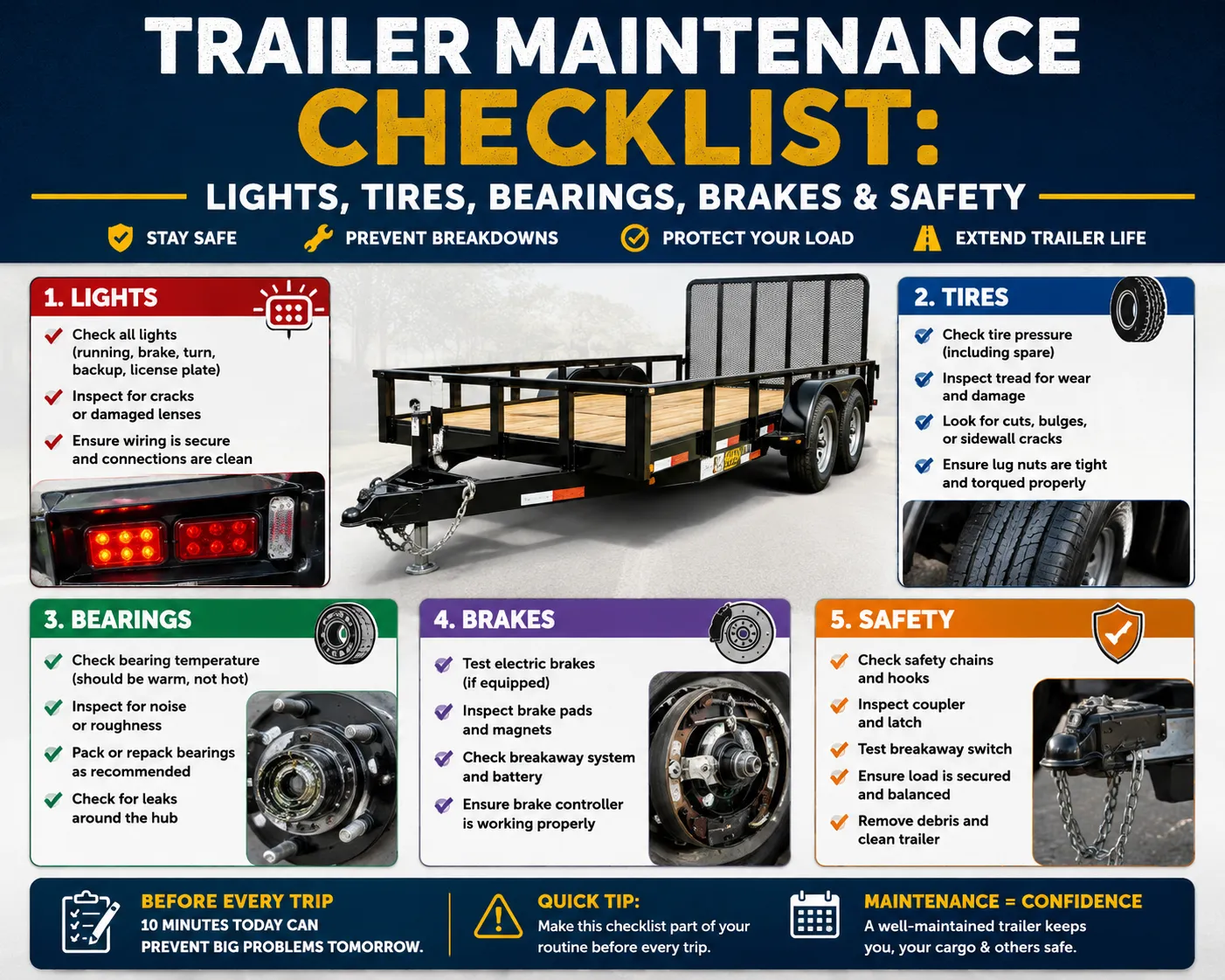
A trailer maintenance checklist keeps small issues from becoming roadside failures. Use this guide before long trips, after storage, and any time a trailer has been sitting unused for more than a few weeks.
This checklist applies to utility trailers, cargo trailers, travel trailers, snowmobile trailers, small equipment trailers, and RV-related hauling setups. Always follow the manufacturer’s manual for torque specs, tire pressure, axle service intervals, brake adjustment, and wiring requirements.
Quick Pre-Trip Trailer Checklist
- Confirm the coupler is fully seated on the hitch ball and locked.
- Cross and attach safety chains with enough slack for turns.
- Plug in the wiring connector and test brake lights, running lights, turn signals, and hazard lights.
- Check tire pressure when tires are cold and inspect for cracks, bulges, uneven wear, or embedded objects.
- Confirm lug nuts are torqued to the trailer manufacturer’s specification.
- Verify the load is balanced, tied down, and within the trailer’s GVWR and tongue weight limits.
- Check trailer brakes and breakaway battery if the trailer is equipped with electric brakes.
- Look underneath for loose wiring, hanging chains, leaks, damaged springs, or bent components.
Trailer Lights and Wiring Checks
Trailer lighting is one of the easiest safety systems to ignore until it fails. Test every light before towing, especially after storage, heavy rain, corrosion exposure, or a recent repair.
- Clean the trailer connector and tow vehicle socket.
- Inspect exposed wires for cuts, loose grounds, cracked insulation, or poorly sealed splices.
- Check that ground wires are secured to clean metal, not paint or rust.
- Replace dim, cracked, water-filled, or intermittent light assemblies.
For a deeper lighting comparison, read Trailerite’s guide to choosing trailer lights.
Tires, Wheels, and Lug Nuts
Trailer tires often age out before they wear out. Sidewall cracks, flat spots, low pressure, and overloaded tires can create heat and failure risk even when tread depth looks acceptable.
- Use the tire pressure listed for the trailer tire, not a guess from passenger vehicle habits.
- Inspect valve stems for cracking and leaks.
- Check the tire date code and replace aged tires before long trips.
- Retorque lug nuts after wheel removal or according to the manufacturer’s break-in guidance.
- Carry a spare tire, jack, and lug wrench that actually fit the trailer.
Bearings, Hubs, and Axles
Wheel bearings support the trailer load and take constant heat, water, and vibration. A neglected bearing can damage the hub, spindle, wheel, and axle.
- Listen for grinding, humming, or squealing from the hub area.
- After a short drive, carefully check whether one hub is much hotter than the others.
- Repack or service bearings at the interval recommended for your trailer and use conditions.
- Inspect grease seals for leakage and replace damaged seals before towing.
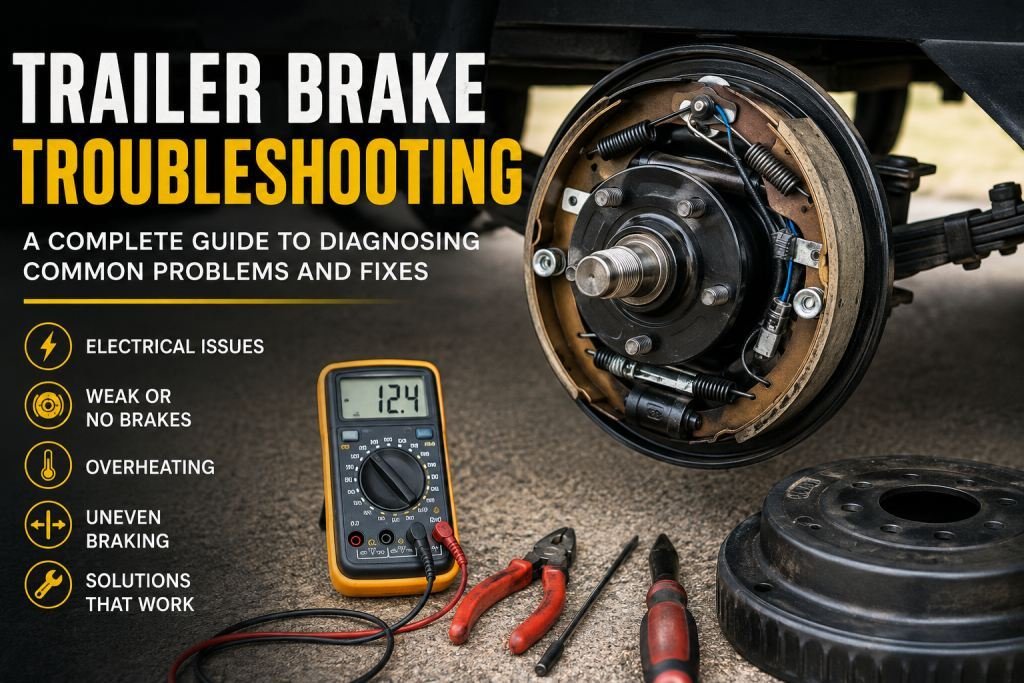
Trailer Brakes and Breakaway System
If your trailer has brakes, they should feel predictable and balanced. Weak braking, grabbing, delayed response, or controller errors should be inspected before the next trip.
- Test the brake controller at low speed in a safe area.
- Check breakaway cable condition and battery charge.
- Inspect brake wiring, magnets, drums, pads, and adjustment as needed.
- Do not tow a loaded trailer with known brake faults.
Frame, Coupler, Jack, and Safety Chains
The hitch connection carries the highest consequence if something fails. Look for rust, cracks, bent metal, loose bolts, coupler wear, jack instability, and damaged safety chain hardware.
- Confirm the coupler size matches the hitch ball.
- Lubricate moving coupler and jack parts where appropriate.
- Replace stretched, cracked, or badly rusted chain hardware.
- Inspect welds and mounting points before carrying heavy loads.
Seasonal Trailer Maintenance
Seasonal maintenance matters most for snowmobile trailers, boat trailers, RV campers, and trailers stored outdoors. Moisture, salt, sun exposure, and long idle periods can age components faster than mileage alone.
- Wash off road salt, mud, and grime after winter or off-road use.
- Dry and ventilate enclosed trailers before storage.
- Protect tires from long-term UV exposure and standing water.
- Inspect roof seams, doors, ramp hinges, and weather stripping.
- For RV storage planning, see our RV camper shed guide.
- For winter hauling, review the snowmobile trailer buyer’s guide.
When to Use a Trailer Repair Shop
Some trailer work is simple, but brake, axle, structural, wiring, and bearing issues can become safety-critical. Use a qualified trailer repair shop if you see repeated light failures, overheating hubs, brake faults, cracked frame components, severe corrosion, suspension damage, or unknown electrical problems.
For help deciding what a shop should inspect, read Trailerite’s trailer repair shop guide.
Trailer Maintenance FAQ
How often should I check trailer tire pressure?
Check trailer tire pressure before every trip while the tires are cold. Also check after storage, major temperature swings, or any time the trailer has carried a heavy load.
How often should trailer bearings be serviced?
Follow the trailer manufacturer’s service interval. Trailers used in water, winter salt, heavy hauling, or frequent long-distance trips usually need more frequent bearing inspection and service.
Why do my trailer lights keep failing?
Common causes include poor ground connections, corrosion in the plug, damaged wiring, water intrusion, blown bulbs, failed LED assemblies, or tow vehicle connector problems.
Should I inspect my trailer after storage?
Yes. Before towing after storage, check tires, lights, brakes, bearings, coupler, safety chains, wiring, and signs of rust, pests, leaks, or moisture damage.
Safety note: This article is a general maintenance guide, not a replacement for your trailer owner’s manual or a qualified inspection. If you are unsure about brakes, bearings, structural damage, or towing capacity, have the trailer inspected before using it.