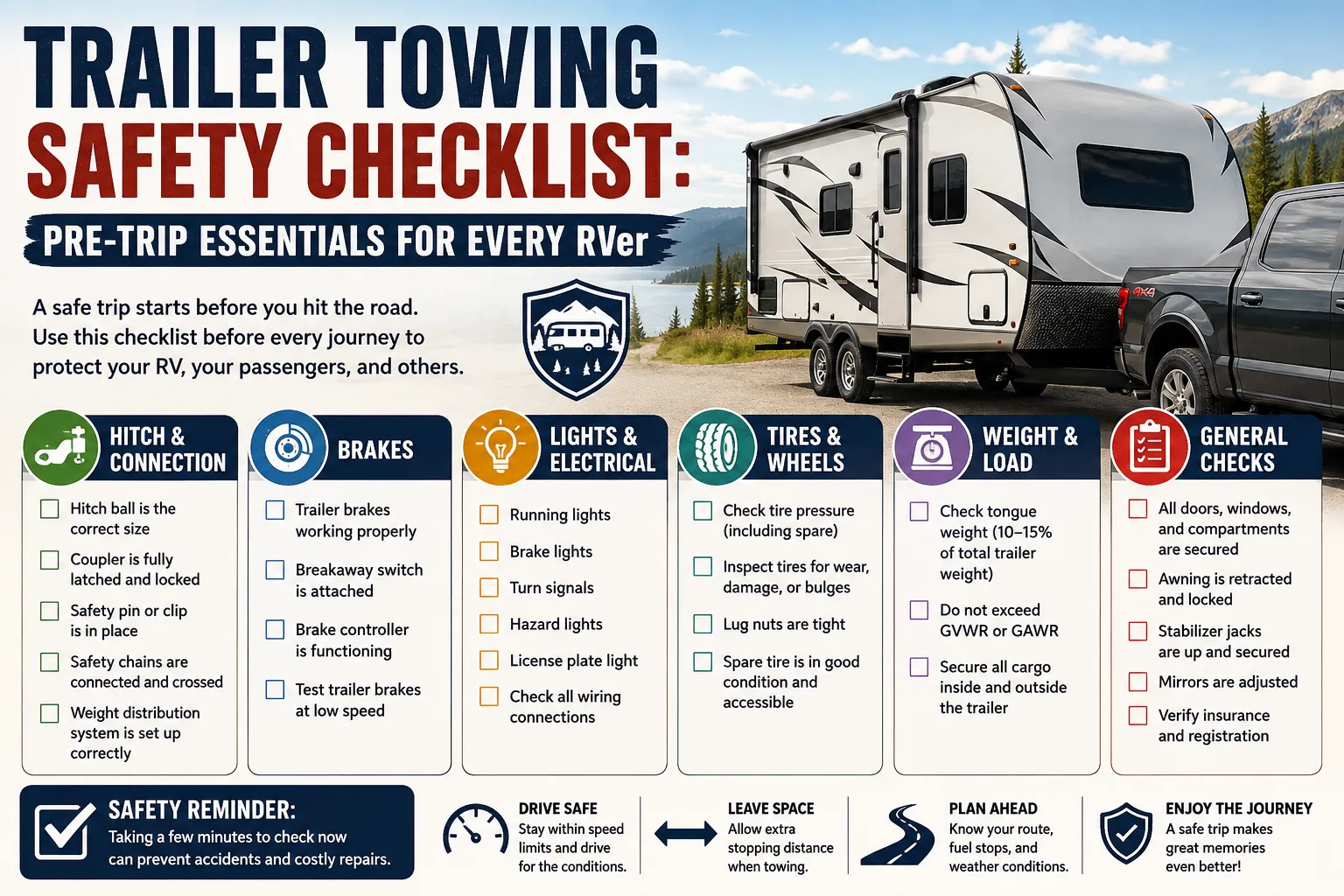
Safety on the open road in 2026 is no longer just about checking your lug nuts and testing your lights. While the mechanical foundations remain critical, the landscape of trailer safety has evolved to include digital health, cybersecurity, and advanced integrated systems. Whether you are hauling a luxury fifth wheel, a compact travel trailer, or a utility rig, your pre-trip ritual is your primary defense against roadside disaster.
In the last 48 hours, new research from the National Motor Freight Traffic Association (NMFTA) has underscored a rising concern: trailer cybersecurity vulnerabilities that can directly impact tractor safety systems. Coupled with a new bipartisan resolution in the US House supporting National Trailer Safety Week, it is clear that 2026 is the year of the proactive trailer owner. This comprehensive 2026 Trailer Towing Safety Checklist is designed to help you navigate these new challenges while reinforcing the timeless mechanical checks that save lives.
The 2026 Pre-Trip Digital Walkaround
As we move deeper into 2026, many trailers are now equipped with ‘Smart Hitch’ technology and integrated telematics. These systems offer incredible convenience, but they also require a new layer of inspection. The NMFTA recently highlighted that compromised trailer telematics can potentially send erroneous signals back to the tow vehicle’s braking and stability control systems. This makes your digital walkaround as important as your physical one.
- Software Update Check: Ensure your trailer’s management app and any onboard firmware are updated to the latest versions. Manufacturers are releasing frequent patches to address cybersecurity vulnerabilities discovered in shared CAN bus architectures.
- Connection Security: If your trailer uses a wireless backup camera or tire pressure monitoring system (TPMS), verify that the signal is encrypted and the pairing is secure to prevent signal interference or hijacking.
- Brake Controller Calibration: Modern electronic brake controllers often recalibrate based on load. Perform a low-speed ‘squeeze test’ of the manual override to ensure the trailer brakes are engaging with the correct intensity before hitting highway speeds.
Why Cybersecurity Matters in 2026
According to NMFTA research, the integration between towed and towing units has reached a point where a digital breach in the trailer can affect the safety performance of the truck. This is particularly relevant for 2026 models utilizing advanced driving assistance systems (ADAS) that rely on data from the trailer to calculate wind sway and braking distances.
The Essential Mechanical Checklist
Mechanical failure remains a leading cause of towing accidents. Recent data from the UK Towing Safety Alliance indicates a ‘maintenance crisis,’ noting that 48% of towing tire failures occur on working trailers that have been under-maintained. Use this 2026 Trailer Towing Safety Checklist to ensure your rig is physically sound.
1. Tires: The 48% Risk Factor
Tires are the most common point of failure. In 2026, we recommend a ‘Triple-T’ check: Tread, Tension, and Temperature.
- Tread Depth: Use a depth gauge to ensure you have at least 4/32″ of tread. Uneven wear often points to axle misalignment or overloaded conditions.
- Tension (Pressure): Always check pressure while the tires are cold. Fluctuating 2026 summer temperatures can cause pressure drops or spikes that lead to blowouts.
- Temperature: Invest in a high-quality TPMS. If one tire is running significantly hotter than the others, it is a warning sign of an impending bearing failure or a dragging brake.
For more detailed information on preventing these issues, see our guide on Trailer Tire Maintenance.
2. The Hitch and Coupler System
The physical bond between your vehicle and trailer must be absolute. In 2026, heavy-duty hitches have become more complex, requiring specific torque settings for weight distribution bars.
- Coupler Lock: Ensure the ball is fully seated and the coupler latch is locked and pinned. A loose coupler is the primary cause of ‘trailer hops.’
- Safety Chains: Cross your chains in an ‘X’ pattern under the tongue. This creates a cradle to catch the tongue if it disconnects, preventing it from digging into the pavement.
- Breakaway Cable: This is often overlooked. Ensure the cable is attached to the vehicle frame, not the hitch itself, and that it has enough slack for turns but not enough to drag.
The 2026 Trailer Safety Comparison Table
Understanding which systems require the most attention can help you prioritize your maintenance schedule. This table compares traditional mechanical risks with emerging 2026 digital risks.
| Safety Component | Traditional Risk | 2026 Emerging Risk | Recommended Check Frequency |
|---|---|---|---|
| Tires | Blowouts/Tread separation | Sensor calibration errors | Every pre-trip |
| Braking | Worn pads/Fluid leaks | Software ‘handshake’ failure | Every 1,000 miles |
| Lighting | Blown bulbs/Corrosion | LED driver/CAN bus error | Every pre-trip |
| Weight | Overloading axles | Improper ADAS calculation | Monthly/Seasonal |
| Coupler | Physical disconnection | Smart-hitch sensor failure | Every pre-trip |
Weight Management and Loading Protocols
Proper weight distribution is the secret to a stable tow. In 2026, many state highway patrols are increasing the frequency of portable scale checks for non-commercial RVers to improve road safety.
- The 60/40 Rule: Always place 60% of your cargo weight in the front half of the trailer (ahead of the axle). This ensures proper tongue weight and prevents the dreaded trailer sway.
- Tongue Weight: Your tongue weight should be between 10% and 15% of the total loaded trailer weight. Too light, and you will experience sway; too heavy, and you will lose steering control in your tow vehicle.
- Lateral Balance: Ensure weight is balanced from side to side. An off-balance trailer can cause uneven braking and increase the risk of a rollover during emergency maneuvers.
If you are unsure about your gear, consult our RV Towing Safety Equipment 2026 Guide to ensure you have the right weight distribution hitch for your load.
National Trailer Safety Week and Legislative Updates
In August 2026, bipartisan support for National Trailer Safety Week has highlighted the need for better education for consumer towers. This initiative emphasizes that trailer safety is a shared responsibility. New 2026 guidelines suggest that even small utility trailers should undergo a professional inspection once a year, focusing on frame integrity and underrun protection.
Euro NCAP recently revealed fatal flaws in many trailer underrun guards, prompting US safety advocates to push for higher standards on fifth-wheel and travel trailer rear bumpers. When performing your checklist, inspect your rear bumper for cracks or rust that could compromise its ability to protect other motorists in the event of a rear-end collision.
On-Road Safety and Emergency Maneuvers
Even with a perfect 2026 Trailer Towing Safety Checklist, you must be prepared for the unexpected. High-speed highway driving requires a different mindset when a trailer is attached.
- The Three-Second Rule: In 2026 traffic densities, double your following distance. It takes significantly longer to stop when hauling 5,000+ lbs of trailer.
- Managing Sway: If your trailer begins to sway, do not slam on the brakes. Instead, hold the steering wheel straight and manually engage the trailer brakes using the controller. This ‘pulls’ the trailer back into line.
- Blind Spot Awareness: Use extended towing mirrors or a high-definition wireless camera system. Modern 2026 blind-spot monitoring systems in trucks are better at detecting trailers, but they are not infallible.
Conclusion: A Culture of Safety
Towing a trailer in 2026 is a blend of mechanical discipline and digital awareness. By following this 2026 Trailer Towing Safety Checklist, you are not just protecting your investment—you are protecting your family and every other driver on the road. The ‘maintenance crisis’ reported by industry experts is avoidable. It starts with a commitment to a 20-minute pre-trip inspection every single time you hitch up. As National Trailer Safety Week reminds us, the goal isn’t just to arrive at your destination; it’s to arrive safely.
Frequently Asked Questions
What is the most important item on a 2026 trailer safety checklist?
While all items are critical, tire pressure and condition remain the most important physical checks, as they account for nearly half of all towing failures. Additionally, verifying the digital ‘handshake’ between the tow vehicle and trailer brakes is now a top priority for 2026.
Does my trailer really need cybersecurity checks?
Yes. 2026 NMFTA research shows that as trailers become more integrated with vehicle safety systems, vulnerabilities in trailer telematics can potentially affect a truck’s braking and stability controls. Keeping firmware updated is now a safety essential.
How do I prevent trailer sway in 2026?
Prevent sway by ensuring 60% of your cargo weight is in the front of the trailer and that your tongue weight is 10-15% of the total load. If sway occurs, manually engage the trailer brakes rather than the vehicle brakes.
When is National Trailer Safety Week in 2026?
National Trailer Safety Week is an annual event supported by bipartisan resolutions (such as the one led by Rep. Pappas in 2026) to promote trailer safety education and pre-trip inspections for all towers.