Elevating Your Adventure: The 2027 Off-Road Standard
As we move into the late 2026 season, the divide between traditional travel trailers and true overlanding rigs has never been wider. For the modern explorer, a standard leaf-spring suspension and a 2-inch ball hitch are no longer sufficient for the washboard roads of the American West or the technical trails of the Ozarks. The shift toward Off-Road Camper Trailer Upgrades in 2027 is defined by one word: resilience. With the recent August 2026 RVIA updates to overlanding safety standards, owners are now looking for integrated systems that handle extreme articulation without compromising structural integrity.
Upgrading a trailer for off-road use is not merely about adding larger tires. It is a holistic re-engineering of the chassis, the power plant, and the coupling points. Whether you are retrofitting an older unit or customizing a 2027 model, understanding the hierarchy of upgrades is essential for safety and longevity in the wild.
Suspension Systems: The Foundation of Ruggedness
The most critical upgrade for any off-road trailer is the suspension. Standard leaf springs are prone to snapping under the high-frequency vibrations of gravel roads, and they offer poor ground clearance. In 2027, the industry has moved toward independent trailing arm systems. These allow each wheel to move independently, preventing the ‘trailer sway’ often induced by uneven terrain.
High-performance systems like the Timbren Axle-Less or the Cruisemaster ATX utilize heavy-duty air springs or coils paired with premium shocks. These systems eliminate the through-axle, significantly increasing ground clearance. When choosing a suspension upgrade, consider the Gross Vehicle Weight Rating (GVWR). An over-sprung trailer will bounce uncontrollably on trails, potentially shaking internal cabinetry loose, while an under-sprung trailer will bottom out on technical obstacles.
For more on how modern tech is changing the ride, see our guide on Active Trailer Suspension, which explains the transition to smart shocks in the 2026-2027 model years.
Articulating Hitches: Eliminating the Bind
A standard ball hitch is a liability on off-road trails. When the tow vehicle is angled up and the trailer is angled down, or when there is significant lateral roll, a standard coupler can bind and snap or even flip the tow vehicle. Off-Road Camper Trailer Upgrades must include an articulating hitch.
These couplers, such as the Max-Coupler or the Cruisemaster DO35, allow for 360 degrees of rotation and significant vertical and horizontal articulation. This ensures that the trailer follows the truck over boulders and through ruts without putting stress on the receiver. The 2027 standards now recommend these for any trailer intended for ‘Level 3’ off-road trails (those requiring 4WD and low-range gearing).
Comparison of Off-Road Coupling Options
| Hitch Type | Degrees of Rotation | Best Use Case | Safety Factor |
|---|---|---|---|
| Standard Ball | Limited | Paved Roads Only | Low (on trails) |
| Pintle & Lunette | High | Military/Industrial | Moderate (Noisy/Slack) |
| Articulating (DO35/Max) | 360 Degrees | Technical Overlanding | Highest |
Chassis Reinforcement and Armor
Off-road travel subjects the trailer frame to immense torsional stress. Many entry-level ‘off-road’ packages only include a lift kit and tires, leaving the thin C-channel frame vulnerable to bending. A true ruggedized upgrade involves reinforcing the frame with box tubing and adding skid plates to protect sensitive components.
Standard plumbing, such as PVC drain lines and exposed gray water tanks, are the first things to fail on a rocky trail. Upgrading to galvanized steel or high-density polyethylene (HDPE) skid plates is mandatory. Furthermore, 2027 builds are increasingly using ‘rock sliders’—steel bars welded to the frame that protect the body panels when navigating tight turns around boulders.
Energy Independence: 48V Systems and Solid-State Power
Off-roaders typically stay far from shore power. In 2027, the gold standard for Off-Road Camper Trailer Upgrades has shifted from 12V to 48V lithium systems. The higher voltage allows for smaller wire gauges, reducing weight, and more efficient operation of high-draw appliances like induction cooktops and air conditioners.
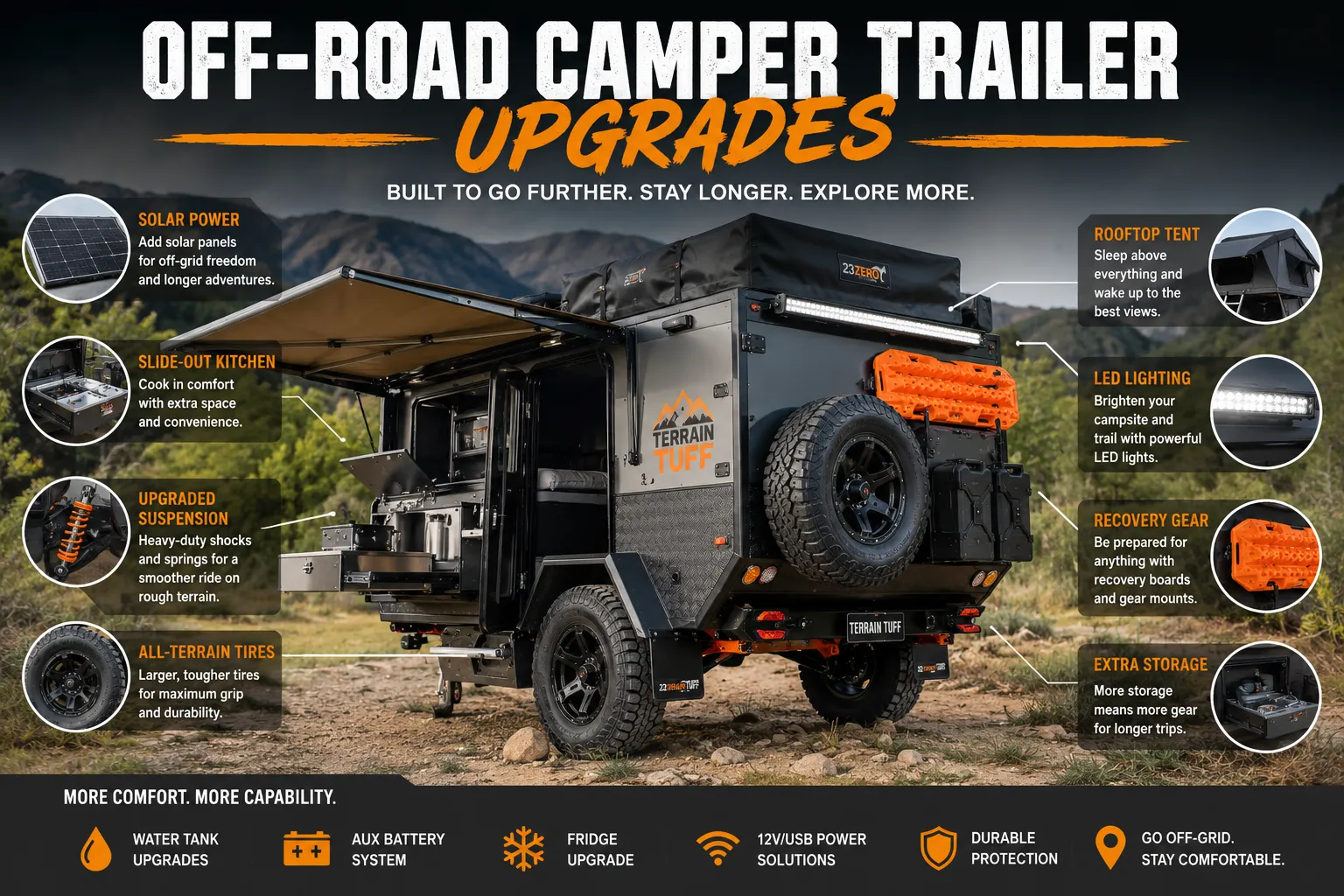
Integrating high-output solar arrays is easier on ruggedized trailers with roof racks designed for the task. New flexible solar panels with ETFE coatings are preferred for off-road use as they resist impact from low-hanging branches better than glass-faced panels. To understand the transition to the latest battery tech, read our deep dive on RV Solid-State Battery Conversion.
Wheel and Tire Selection for Variable Terrain
Selecting the right tires for your off-road trailer requires a different philosophy than selecting truck tires. While the truck needs traction to pull, the trailer needs lateral stability and puncture resistance. In 2027, the trend is toward All-Terrain (A/T) tires with ‘D’ or ‘E’ load ratings and reinforced sidewalls.
- Mud-Terrain (M/T) Tires: Excellent for soft soil but can be heavy and loud. They often have more rolling resistance, which can decrease fuel economy on the highway.
- All-Terrain (A/T) Tires: The balanced choice for most overlanders. They provide enough grip for gravel and dirt while maintaining highway manners.
- Beadlock-Capable Wheels: For those tackling deep sand or extreme mud, beadlock wheels allow you to drop tire pressure to single digits without the tire slipping off the rim.
Water Management and Filtration
In remote areas, water is your most precious resource. Standard camper trailers often have exposed fresh water tanks that can freeze or be punctured. Upgrading involves moving these tanks inside the insulated floor structure or adding heating pads and 1/4-inch aluminum shields. For 2027, many overlanders are installing UV-LED filtration systems that allow them to draw water from mountain streams and safely fill their tanks, extending their time off-grid significantly.
This self-sufficiency is a hallmark of the Boondocking Camper Trailer Setup, which focuses on the logistical side of long-term remote stays.
Exterior Enhancements: Kitchens and Lighting
Overlanding is as much about the campsite as the trail. Upgrading to a slide-out stainless steel kitchen allows for cooking outside, keeping the interior of the trailer free from heat and odors. In 2027, these kitchens often include 12V induction burners powered by the trailer’s lithium bank, eliminating the need for bulky propane tanks.
Lighting is another crucial safety upgrade. High-intensity LED scene lights on all four sides of the trailer are essential for setting up camp after dark in unfamiliar territory. These should be wired to a central ‘smart’ controller that can be operated via a smartphone or a physical switch panel near the door.
Recovery Gear and Trail Safety
Finally, no off-road trailer is complete without recovery points. In the event the trailer becomes high-centered or stuck in deep mud, you must have frame-mounted recovery points rated for at least 1.5 times the trailer’s GVWR. Standard bumpers are not designed for recovery and will likely be ripped off if used as a winch point.
Carry a dedicated off-road kit including MaxTrax recovery boards, a high-lift jack with a trailer-specific adapter, and a kinetic recovery rope. As of 2026, many off-road trailers are also being equipped with integrated ‘rock lights’ underneath the chassis, which help the driver or a spotter see obstacles and potential hang-ups in low-light technical sections.
Conclusion: Building for the Unknown
The Off-Road Camper Trailer Upgrades you choose in 2027 should reflect the specific terrain you plan to conquer. While a suspension upgrade is universal, the level of armor, power, and water filtration required depends on whether you are weekend-warrior camping or embarking on a multi-month expedition. By focusing on the fundamentals of articulation, protection, and power, you can transform a standard camper into a vessel capable of reaching the most beautiful, untouched corners of the continent. Ensure all modifications are performed by certified technicians to maintain your trailer’s structural integrity and your peace of mind.
Frequently Asked Questions
Can I upgrade my existing travel trailer for off-road use?
Yes, but it is limited by the frame. While you can add a lift kit and articulating hitch, standard C-channel frames may not handle the torsional stress of technical trails. Chassis reinforcement is recommended for true off-roading.
What is the best hitch for off-road camper trailers in 2027?
Articulating hitches like the Cruisemaster DO35 or the Max-Coupler are the industry standards for 2027. They allow 360-degree rotation and prevent binding on uneven terrain.
Do off-road tires on a trailer affect fuel economy?
Yes. Aggressive mud-terrain tires increase rolling resistance and weight, which can decrease fuel efficiency by 1-3 MPG depending on the tow vehicle and trailer size.
Why are 48V power systems becoming popular for off-road trailers?
48V systems are more efficient for high-draw appliances like AC and induction stoves, use thinner (lighter) wiring, and integrate better with modern high-output solar arrays.