
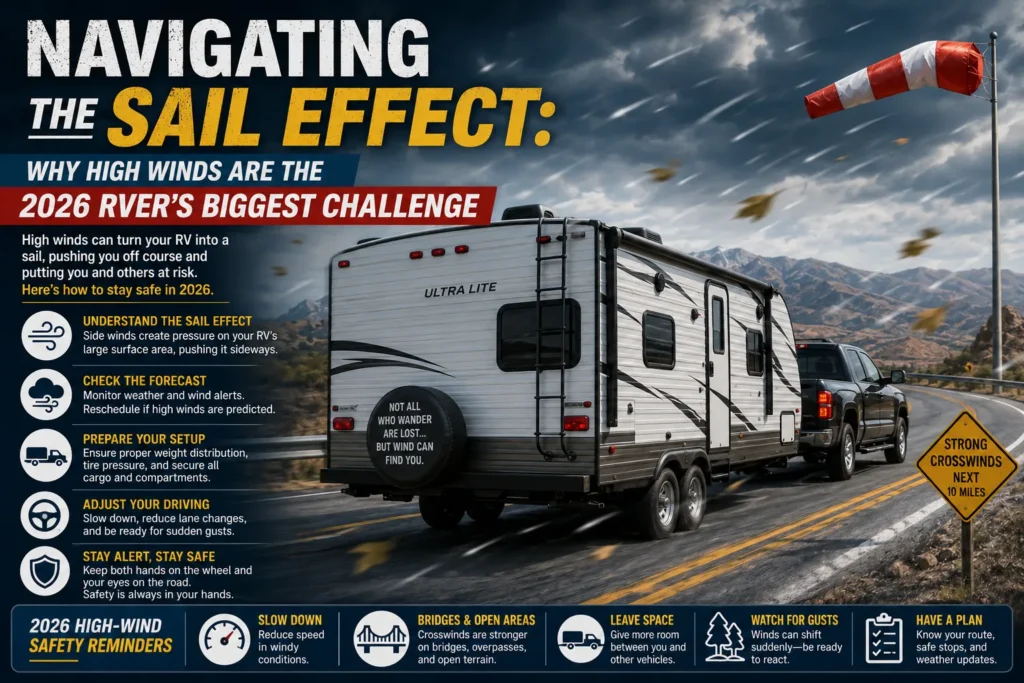
Navigating the Sail Effect: Why High Winds are the 2026 RVer’s Biggest Challenge
As we move through the peak of the 2026 summer travel season, towers are facing a new reality: atmospheric volatility. The American landscape is seeing more frequent and more intense wind events, from localized microbursts to sustained crosswinds in the Great Plains. For anyone pulling a travel trailer or a fifth wheel, your rig is essentially a giant sail. Understanding how to manage that sail can be the difference between a successful vacation and a dangerous roadside incident.
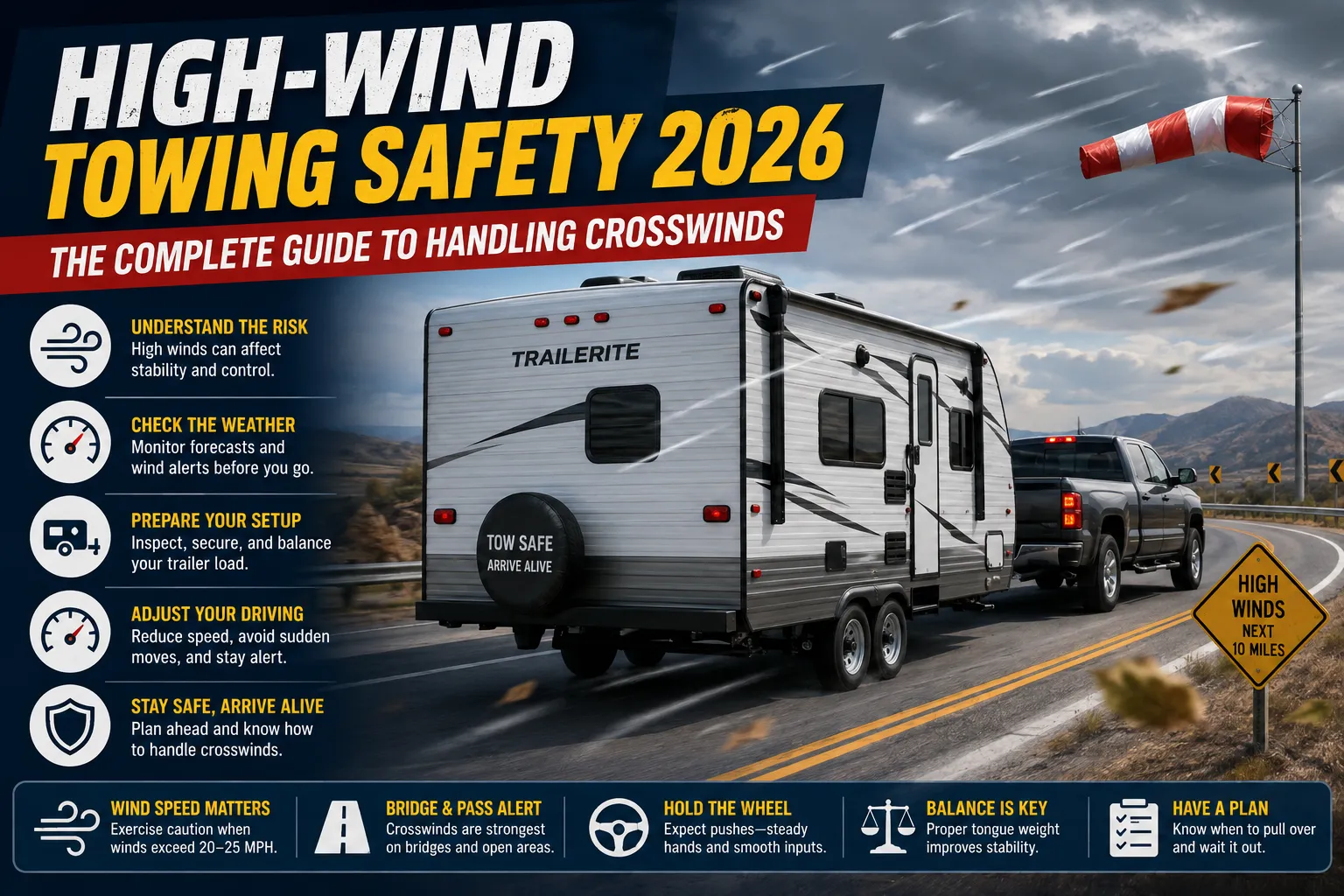
Towing in high winds requires more than just a firm grip on the steering wheel. It demands an understanding of physics, the right technology, and a practiced set of reflexes. This guide breaks down the essential 2026 protocols for maintaining control when the wind tries to take it away from you.
The Physics of Lateral Force: Understanding Crosswinds
When you are driving a solo truck, a 30-mph gust might feel like a slight nudge. However, when you add a 30-foot trailer, that same gust exerts thousands of pounds of lateral force against the side of your rig. This is known as the “Sail Effect.” Because the trailer is connected to your tow vehicle via a pivot point (the hitch), that lateral force is converted into torque. This torque attempts to rotate the tow vehicle, leading to the dreaded phenomenon of trailer sway.
In 2026, we also have to consider the “Bow Wave” effect from passing semi-trucks. Modern aerodynamically optimized freight trucks push a massive volume of air to the side. When one passes you in high-wind conditions, the combination of the natural wind and the truck’s bow wave can create a vacuum effect that pulls your trailer toward the semi, followed immediately by a gust that pushes it away.
The 2026 Technology Suite: Active Wind Mitigation
The safety landscape has changed significantly this year. Most 2026 model year heavy-duty trucks now come standard with integrated Trailer Sway Control (TSC) that communicates directly with the trailer’s electric brakes. These systems use gyroscopic sensors to detect the onset of sway before the driver even feels it.
However, technology is not a substitute for proper configuration. You must still ensure your hardware is up to the task. If you haven’t yet optimized your physical connection, refer to our guide on 2026 Weight Distribution Hitch Setup to ensure your rig is balanced enough to handle lateral loads.
Electronic Stability Programs (ESP)
Modern ESP systems in 2026 can now apply individual brakes on the trailer without the driver touching the brake controller. This “asymmetric braking” pulls the trailer back into alignment by creating counter-drag on the side opposite the sway.
Actionable List: The 7-Step Crosswind Recovery Protocol
If you find yourself in a sudden high-wind event and the trailer begins to oscillate, follow this 2026-standardized recovery protocol immediately:
- Stay Off the Vehicle Brakes: Your first instinct is to slam on the truck’s brakes. Don’t. This can cause the trailer to jackknife. Let off the accelerator gradually instead.
- Manual Brake Controller Activation: Use the manual slider on your brake controller to apply the trailer brakes only. This “stretches” the rig out and pulls the trailer back into a straight line behind the tow vehicle.
- Fix Your Eyes on the Horizon: Do not look at the trailer in your mirrors. Look far down the road where you want to go. Your hands will naturally follow your eyes.
- Steer Straight: Do not attempt to “counter-steer” the sway. This often leads to over-correction, which amplifies the oscillation. Hold the wheel firm and straight.
- Reduce Speed Gradually: Once the sway is controlled, reduce your speed to at least 10 mph below the speed limit or until you feel the rig stabilize.
- Find the Next Safe Exit: Do not try to “power through” a wind event. If gusts are exceeding 35 mph, it is time to find a protected area to park.
- Check Your Load: Once parked, check if your cargo has shifted. A shift in weight to the rear of the trailer is the leading cause of increased wind sensitivity.
Pre-Trip Wind Planning: Tools and Thresholds
In 2026, we have access to high-resolution wind modeling that was unavailable a few years ago. Before you hitch up, you should consult tools like the National Weather Service wind maps. Look for “sustained winds” versus “gusts.”
A good rule of thumb for 2026 travel trailers is the 15/25 rule:
- 15 MPH Sustained: You will start to feel the wind. Increase following distance.
- 25 MPH Sustained: This is the limit for most novice drivers. High-profile trailers (like fifth wheels) should consider stopping.
- 35 MPH Gusts: Extreme danger territory. Even experienced drivers should seek shelter.
The Role of Tire Health in Wind Stability
Your tires are the only thing keeping that lateral force from sliding you off the road. Under-inflated tires have softer sidewalls, which allow for more “squirm.” This squirm contributes significantly to trailer sway. Before heading into a known wind corridor, check your pressures. For more on preventing wind-related failures, see our article on RV Tire Blowout Prevention 2026.
The Drafting Trap: Passing and Being Passed
One of the most dangerous moments when towing in high winds is when you are being passed by a larger vehicle. In 2026, many interstate lanes have been narrowed to accommodate autonomous trucking corridors, leaving less room for error. When a semi-truck passes you, the air is compressed between the two vehicles. This creates a high-pressure zone that pushes you apart, followed by a low-pressure zone that sucks you back together.
To mitigate this, move as far to the right of your lane as safely possible when you see a semi approaching in your mirror. This increases the air gap and reduces the pressure differential.
Essential Wind-Ready Inspection Checklist
Use this table to verify your rig’s readiness before entering high-wind regions like the I-80 corridor or the Southwest deserts.
| Component | Inspection Focus | Ideal State for Wind |
|---|---|---|
| Tongue Weight | Scale measurement | 10-15% of total trailer weight |
| Tire Sidewalls | Pressure and cracking | Inflated to Max Cold PSI (check placard) |
| Sway Bar Friction | Adjustment bolt tightness | Tightened to manufacturer spec for load |
| Gain setting | Set high enough to feel drag when manual slider is used | |
| Cargo Distribution | Center of gravity | Heavy items low and over the axles |
Emergency Maneuvers: The Last Resort
What happens if a gust is so strong it actually begins to lift the windward tires of the trailer? This is an extreme emergency. In this scenario, you must act counter-intuitively. While we usually say “don’t steer into it,” if the trailer is physically tipping, you must steer slightly in the direction of the wind to “catch” the trailer and put the wheels back down, then immediately apply the manual trailer brakes to straighten the rig. This is a high-skill maneuver that emphasizes why stopping before the wind reaches 40 mph is critical.
Safe Stopping: Where to Hide from the Wind
Not all parking spots are created equal during a wind event. If you are forced to stop, do not park broadside to the wind. If the wind is coming from the West, park facing North or South so the wind hits your narrowest profile (the front or back). If possible, park on the leeward side of a large building or a thick grove of trees. Avoid parking under highway overpasses, as these can create a “venturi effect,” actually accelerating the wind speed through the tunnel.
Conclusion: Respect the Elements
Towing in high winds in 2026 is a test of patience and preparation. By utilizing the latest electronic stability aids, maintaining perfect tire pressure, and knowing when to call it a day, you can ensure that your journey remains safe. Remember: no destination is worth a rolled rig. The most successful towers are those who have the humility to pull over and wait for the weather to clear.
Frequently Asked Questions
At what wind speed should I stop towing a trailer?
Most experts and the NHTSA recommend that novice drivers stop towing when sustained winds reach 25 mph. Experienced drivers should consider stopping when gusts exceed 35 mph, as the risk of rollover increases exponentially.
Should I use cruise control when towing in high winds?
No. Never use cruise control in high winds or slippery conditions. You need direct control over the throttle to manage speed variations and to respond instantly to sway events.
Does a weight distribution hitch help with wind?
Yes. A weight distribution hitch with integrated sway control is essential. It helps keep the front tires of the tow vehicle planted, providing the steering authority needed to stay straight during a gust.
What is the 7-step crosswind recovery protocol?
It is a safety sequence: stay off vehicle brakes, use the manual trailer brake slider, look at the horizon, steer straight, reduce speed gradually, find an exit, and check your load balance.