Why the 2026 Fifth Wheel Market is Redefining Road Travel
The 2026 fifth wheel market has officially shifted from being a niche luxury segment to the primary choice for full-time RVers and digital nomads. Unlike traditional travel trailers, fifth wheels offer a unique multi-level design that creates a clear separation between living, sleeping, and working areas. This architectural depth is what makes them feel more like a brick-and-mortar home than a vehicle. As we move through the 2026 season, manufacturers have focused on three core pillars: energy independence, smart automation, and weight efficiency.

Choosing a fifth wheel in 2026 requires understanding more than just aesthetics. With new lightweight composites allowing larger rigs to be towed by 3/4-ton trucks, the barrier to entry has lowered, but the complexity of features has increased. Whether you are looking for a bunkhouse for a family or a rear-den floorplan for a quiet office, this guide breaks down the essential criteria for making a smart investment in 2026.
Comparing Fifth Wheels to Travel Trailers: The 2026 Perspective
The primary difference remains the hitching mechanism. A fifth wheel uses a kingpin that connects to a U-shaped hitch in the bed of a pickup truck. This positioning places the trailer weight directly over the truck’s rear axle, which significantly improves stability. In 2026, we are seeing advanced pin box technologies like the Rota-Flex and Trailair being standardized on mid-range models to further reduce the ‘chucking’ sensation during transit.
While travel trailers are often lighter and more versatile for small campsites, fifth wheels dominate in ceiling height and storage capacity. For those planning to visit locations with strict size limits, it is essential to consult the 2027 National Park RV Size Restrictions, as many modern fifth wheels now exceed the 35-foot threshold commonly found in older campgrounds.
Understanding 2026 Fifth Wheel Categories
In 2026, the market is broadly divided into three segments based on weight, construction, and intended use. Identifying which category fits your needs is the first step in narrowing your search.
1. Ultra-Lite and Half-Ton Towables
These units are designed for owners of modern half-ton and 3/4-ton trucks. They typically range from 25 to 30 feet and utilize vacuum-bonded lamination to keep the Gross Vehicle Weight Rating (GVWR) under 10,000 lbs. While they offer the stability of a fifth wheel, they often compromise on tank sizes and insulation thickness.
2. Mid-Profile Fifth Wheels
The mid-profile segment is the ‘sweet spot’ for most 2026 buyers. These units range from 32 to 38 feet and often include features like automatic leveling, dual AC units, and residential refrigerators. They are generally built for ‘extended season’ use, meaning they have heated and enclosed underbellies but may not be rated for extreme sub-zero living.
3. Full-Profile Luxury Rigs
These are the flagships of the RV world. Often exceeding 40 feet and 14,000 lbs, these units require a 1-ton dually truck at minimum. In 2026, luxury rigs are featuring ‘smart glass’ windows that tint with a smartphone app, full-body paint, and massive solar arrays. Many of these units are now built on a drop-frame chassis, providing massive ‘pass-through’ storage that can accommodate everything from kayaks to outdoor kitchen setups.
Key Features to Look for in 2026 Models
When walking the dealer lots this year, you will notice several technological leaps that were optional just two years ago. Pay close attention to these high-value upgrades:
- Unified Control Systems: Most 2026 models utilize systems like OneControl or RV-C bus architecture. These allow you to monitor tank levels, extend slides, and control lighting from a central touchscreen or your smartphone.
- Enhanced Solar Capacity: With the rise of off-grid camping, look for rigs pre-wired for 600W+ solar packages. If you are planning to boondock, consider calculating your needs using a 2026 RV Solar Generator Sizing Guide to ensure your battery bank can handle the residential-style appliances.
- Lithium-Ready Power Centers: 2026 has seen a major shift away from Lead-Acid batteries. High-end fifth wheels now come standard with LiFePO4 (Lithium Iron Phosphate) batteries, which offer longer lifespans and deeper discharge rates.
- Disc Brakes: While electric drum brakes are still common on entry-level units, many 2026 luxury models are moving toward hydraulic disc brakes for superior stopping power on steep mountain grades.
Towing Requirements: Don’t Trust the Salesman
One of the most common mistakes in the fifth wheel world is relying on ‘dry weight’ numbers. These figures represent the trailer as it leaves the factory—empty of water, propane, and your gear. In 2026, the average RVer adds between 1,500 and 2,500 lbs to the unit once loaded.
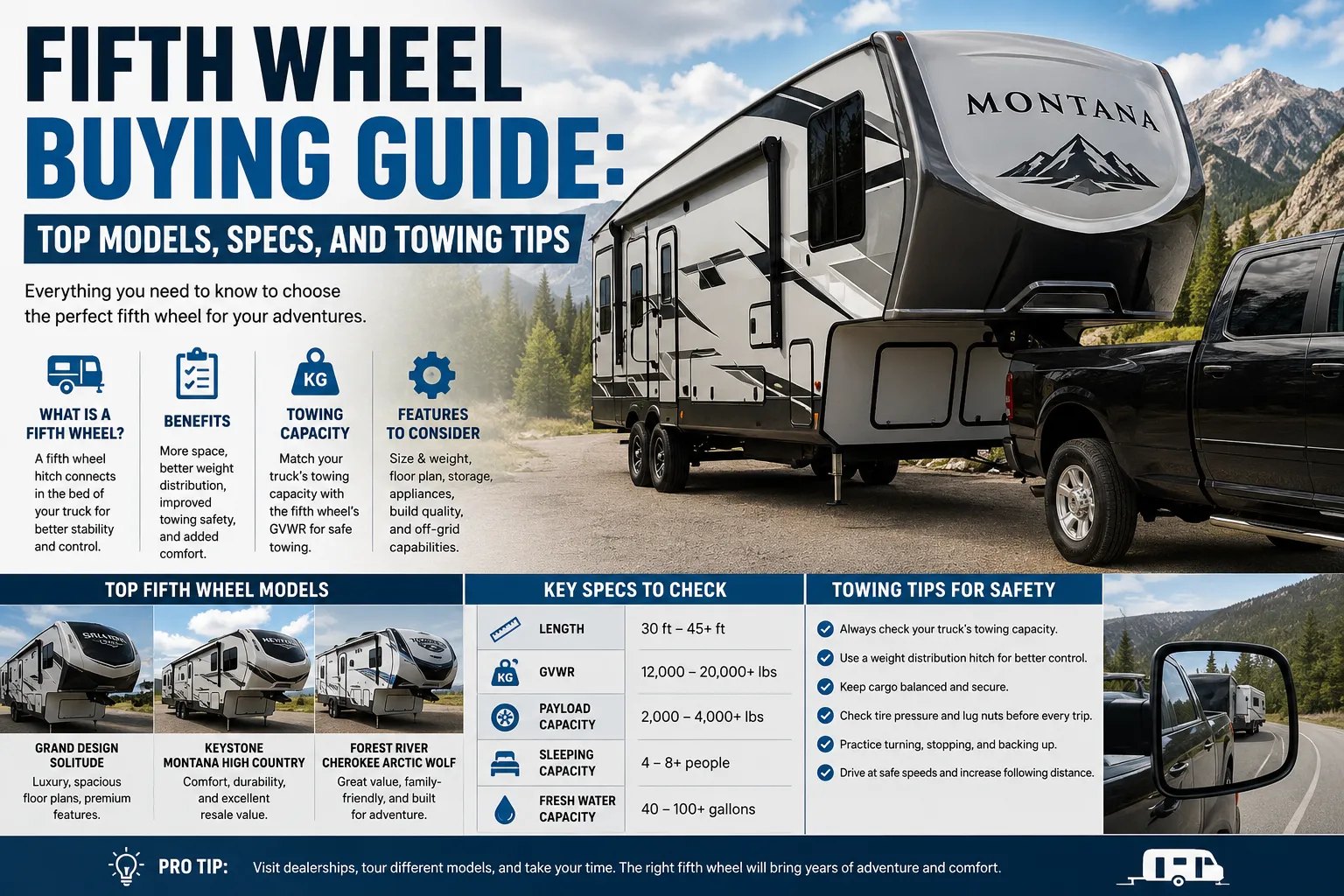
When matching a truck to a 2026 fifth wheel, the most critical number is Payload Capacity, not just Towing Capacity. Because 20% to 25% of a fifth wheel’s weight sits directly in the truck bed (the pin weight), you can easily exceed your truck’s payload limit before you ever hit your towing limit. Always check the tire and loading information sticker on your truck’s driver-side door jamb for the actual capacity of your specific vehicle.
Comparison: 2026 Fifth Wheel Specs by Tier
| Feature | Ultra-Lite (Entry) | Mid-Profile (Mid-Tier) | Luxury (Premium) |
|---|---|---|---|
| Average Length | 26–30 feet | 32–38 feet | 39–45 feet |
| Average GVWR | 7,500–10,000 lbs | 11,000–14,500 lbs | 15,000–20,000+ lbs |
| Pin Weight Range | 1,200–1,800 lbs | 2,000–2,800 lbs | 3,000–4,500 lbs |
| Construction | Alunimum/Laminate | Alunimum/High-Gloss | Steel/Full-Body Paint |
| Standard Battery | Single Lead-Acid | Dual AGM or Lithium | Multi-Bank Lithium |
The Importance of Insulation and HVAC
As 2026 brings more extreme weather patterns, the ‘R-value’ of your fifth wheel is more important than ever. High-end manufacturers like Grand Design and Northwood (Arctic Fox) are now emphasizing ‘True Four-Season’ construction. This involves more than just a furnace; it requires radiant foil barriers, insulated pex plumbing lines, and dual-pane windows.
In 2026, many mid-to-high-tier fifth wheels are moving away from traditional noisy roof-top AC units in favor of ‘V-ducted’ or ‘basement-mounted’ HVAC systems. These systems are up to 50% quieter and use variable-speed compressors that can run more efficiently on solar power or small generators. If you plan to spend time in the Southwest or the Pacific Northwest, investing in dual-pane windows is the single most effective way to manage interior climate and noise levels.
Pre-Delivery Inspection (PDI) Checklist
Never sign the final paperwork for a 2026 fifth wheel without a thorough inspection. Even the most expensive rigs can have factory defects. Use this checklist during your walk-through:
- Roof Seals: Check all self-leveling lap sealant for bubbles or cracks.
- Slide Operation: Run every slide out and in three times. Listen for grinding or stalling.
- Hydraulics: Check the leveling jacks for any sign of fluid leaks or ‘popping’ noises.
- Plumbing: Fill the fresh tank and run all faucets. Look under sinks for drips.
- Electronics: Ensure the 2026 smart-control app pairs correctly with the unit and controls all systems.
Managing Cost of Ownership
The sticker price of a 2026 fifth wheel is just the beginning. Expect to budget for the following annual expenses:
Insurance: Depending on whether you are a recreational user or a full-timer, insurance can range from $1,200 to $3,500 annually. Full-timer policies include liability coverage similar to a homeowner’s policy.
Storage: If you cannot park a 40-foot rig at home, covered storage averages $150–$300 per month. Maintenance: Even new units require annual roof inspections, wheel bearing packing, and slide-out seal conditioning. Budget roughly 1% to 2% of the purchase price annually for upkeep.
Conclusion: Is a Fifth Wheel Right for You in 2026?
The 2026 fifth wheel offerings are more sophisticated than ever, providing a true ‘home on wheels’ experience. While the towing requirements are more demanding than those of a travel trailer, the payoff in stability, space, and luxury is undeniable. By matching your truck’s payload to the rig’s GVWR and prioritizing high-quality insulation and modern electronics, you can ensure your investment provides years of reliable adventure. As the market continues to evolve, those who focus on build quality and energy independence will find the greatest satisfaction in the open road.
Frequently Asked Questions
Can I tow a 2026 fifth wheel with a half-ton truck?
Only specific ‘Half-Ton Series’ or ‘Ultra-Lite’ models with a pin weight under 1,500 lbs and a GVWR under 10,000 lbs are suitable for half-ton trucks. Always verify your specific truck’s payload capacity on the door jamb sticker.
What is the average price of a 2026 fifth wheel?
Entry-level models start around $45,000, mid-profile units range from $70,000 to $110,000, and luxury full-profile rigs can exceed $160,000 depending on options.
Do I need a special license to tow a large fifth wheel?
In most US states, a standard Class C license is sufficient. However, states like California, Texas, and Pennsylvania may require a non-commercial Class A or B license if the trailer’s GVWR exceeds 15,000 or 26,000 lbs.
Which is better: a fifth wheel or a destination trailer?
A fifth wheel is designed for frequent travel and towing stability. A destination trailer is designed for seasonal stays in one location and lacks the aerodynamic front and heavy-duty suspension of a fifth wheel.