Mastering the Mountains: Why 2026 Standards Matter
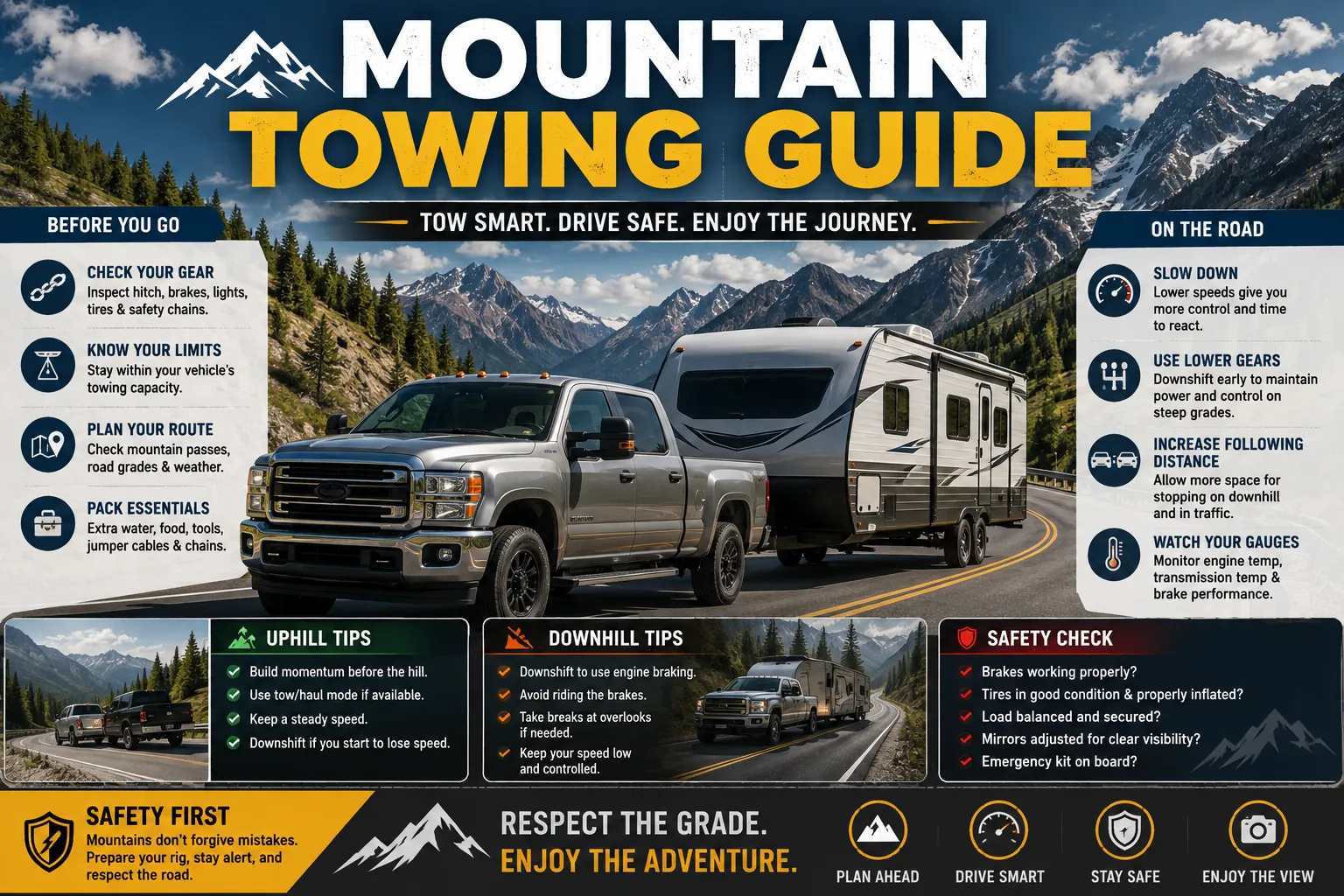
Towing a trailer on level ground is one thing, but tackling a 7% grade in the heart of the Rocky Mountains is a different beast entirely. For 2026, as vehicles become more advanced with hybrid powertrains and regenerative braking systems, the fundamentals of Mountain Towing Techniques remain the bedrock of safety. Whether you are hauling a 10,000-pound fifth wheel or a lightweight travel trailer, gravity and heat are your two primary adversaries when the road starts to tilt.

In response to increasing incidents on steep passes, the National Highway Traffic Safety Administration (NHTSA) recently updated their high-altitude towing protocols. These updates emphasize the importance of mechanical sympathy—the ability to understand what your vehicle is feeling—and the strategic use of modern auxiliary braking systems. This guide breaks down the essential skills required to conquer the climb and, more importantly, survive the descent.
The Ascent: Managing Power and Heat
The climb is often what people fear most, primarily due to the sight of the temperature gauge creeping toward the red zone. In 2026, even the most capable heavy-duty trucks can struggle with thermal management when ambient air temperatures exceed 90 degrees Fahrenheit at high altitudes. Thinner air means less oxygen for your engine and less cooling for your radiator.
Transmission and Engine RPM Management
The biggest mistake towers make during an ascent is trying to maintain highway speeds. High speeds under load generate massive amounts of heat in the transmission. Instead of relying on your vehicle’s automatic logic, consider manually downshifting to keep your RPMs in the ‘power band.’ For diesel engines, this is usually between 1,800 and 2,400 RPM; for gasoline engines, you may need to sit between 3,500 and 4,500 RPM.
- Watch the Gauges: Modern trucks allow you to monitor transmission fluid temperature and oil temperature. If your transmission fluid exceeds 230°F, it is time to slow down. If it hits 250°F, you must pull over and let the engine idle to circulate coolant.
- Turn Off the A/C: It sounds like an old-school tip, but in 2026, the A/C compressor still adds significant load to the engine. If you see temperatures rising, sacrifice your cabin comfort for the health of your engine.
- The 4-Way Flasher Rule: If you cannot maintain at least 45 MPH on an interstate grade, turn on your hazard lights. This alerts faster-moving traffic and complies with DOT safety standards.
The Descent: Gravity is the Enemy
While the climb is hard on your engine, the descent is hard on your life. Brake fade is a terrifying phenomenon where your brake pads and rotors become so hot they can no longer generate friction. This is why Mountain Towing Techniques focus heavily on engine braking and the ‘Stab Braking’ method.
The Art of Engine Braking
The golden rule of mountain towing is that you should descend a grade in the same gear you used to climb it. By downshifting to a lower gear, you use the engine’s compression to slow the vehicle, a process known as engine braking. If you have a diesel truck equipped with an exhaust brake (often called a ‘Jake Brake’ in the trucking world), ensure it is engaged before you begin the descent.
Mastering the ‘Stab Braking’ Technique
If your speed continues to rise despite engine braking, do not ‘ride’ your brakes. Light, continuous pressure is what leads to overheating and failure. Instead, use stab braking:
- Allow your speed to reach the maximum safe limit for the curve (e.g., 55 MPH).
- Apply the brakes firmly and quickly to reduce your speed by 10 to 15 MPH (e.g., down to 40 MPH).
- Completely release the brakes to allow the rotors to air-cool.
- Repeat as necessary.
This method ensures the brakes are only in contact with the rotors for a few seconds at a time, preventing the build-up of catastrophic heat. For more on keeping your braking system in top shape, check out our guide on Trailer Brake Troubleshooting.
Comparing 2026 Powertrains in Mountainous Terrain
Different engines behave differently under high-altitude stress. The following table highlights what to expect from modern 2026 tow vehicles on steep grades.
| Engine Type | Climbing Performance | Descent Control | Primary Concern |
|---|---|---|---|
| Turbo Diesel | Excellent; high torque at low RPM. | Superior; integrated exhaust brakes. | DEF consumption and cooling. |
| Naturally Aspirated Gas | Good; requires high RPM. | Moderate; relies on gear reduction. | Loss of power at high altitude. |
| Hybrid / EV | Instant Torque; very capable. | Variable; relies on regenerative braking. | Battery thermal management. |
Preparation: The 48-Hour Pre-Mountain Checklist
Your journey to the peaks should begin two days before you hit the first grade. High-altitude environments exacerbate existing mechanical weaknesses. According to the SAE J2807 towing standards, your vehicle’s performance is rated based on specific temperature and elevation variables; staying within these limits is critical.
Check the Cooling System
Check your coolant levels and the condition of your hoses. In 2026, many manufacturers have switched to long-life organic acid technology (OAT) coolants; do not mix different types of coolant, as this can lead to ‘sludging’ that clogs your radiator during a critical climb.
Brake Inspection
Inspect your trailer brake pads. If they are at less than 25% thickness, replace them before attempting a mountain pass. Additionally, ensure your brake controller is properly calibrated. For those using newer tech, refer to our 2026 RV Towing Safety Equipment guide to ensure your electronic stability controls are synced.
Tire Pressure and Elevation
As you increase in altitude, the atmospheric pressure changes. However, the internal pressure of your tires will also appear to change. Always check tire pressures in the ‘cold’ state at your current elevation. Under-inflated tires on a heavy trailer generate excess heat, which can lead to a blowout on a winding mountain road where there is no shoulder to pull over.
Emergency Situations: Runaway Ramps and Brake Failure
Even with the best Mountain Towing Techniques, things can go wrong. If you feel your brake pedal go soft or smell a heavy, acrid ‘burning’ scent, you are in a brake fade situation.
Using Runaway Truck Ramps
Runaway ramps are not just for 18-wheelers. If you lose your brakes, do not hesitate to use them. These ramps are usually filled with deep pea gravel or nets designed to stop a vehicle safely.
- Stay in the Center: Aim for the middle of the ramp to avoid flipping or hitting side barriers.
- Do Not Exit the Vehicle: Once you stop, stay in the vehicle. The gravel is unstable, and the heat from your brakes could potentially start a small fire in the surrounding debris.
- Call for Help: Once stopped, use your satellite messenger or cell phone to call for a heavy-duty tow recovery team.
Dealing with a ‘Boil Over’
If your engine overheats on the way up, pull over as soon as it is safe. Do not turn the engine off immediately. Instead, shift into park and keep the engine idling. This allows the water pump and fan to continue moving coolant through the block. Open the hood to let heat escape, but never attempt to open the radiator cap on a hot engine.
The Importance of Weight Distribution in High Winds
Mountain passes are notorious for high-velocity wind tunnels. A trailer that behaves perfectly in the valley can become a dangerous pendulum at the summit. Proper weight distribution is essential for maintaining traction on your steering axle during these gusts. If you are unsure of your current setup, reviewing the FMCSA guidelines on cargo securement and weight balance can provide additional safety layers for your trip.
In 2026, many towers are utilizing active sway control systems. These systems use the trailer’s own brakes to ‘pulse’ and pull the trailer back into line when it detects lateral movement from wind or passing semi-trucks. However, these systems should be a backup to—not a replacement for—a properly loaded trailer with 10-15% of its weight on the tongue.
Summary: Respect the Grade
Mountain towing is a rewarding way to see the most beautiful parts of the country, but it requires a level of focus and preparation that flat-land towing does not. By mastering engine braking, utilizing the stab braking technique, and keeping a close eye on your vehicle’s vitals, you can navigate even the steepest passes with confidence. Remember, it is not about how fast you get to the top; it is about how safely you get to the bottom.
Quick Safety Checklist for Mountain Passes
- Check trailer brake gain settings at the base of the mountain.
- Ensure all cargo is secured to prevent shifting on 8% grades.
- Verify that your transmission is in ‘Tow/Haul’ mode.
- Monitor the weather for ‘summit snow’ or high-wind advisories.
- Locate the runaway ramps on your GPS before starting the descent.
Frequently Asked Questions
What is the ‘stab braking’ technique?
Stab braking involves applying the brakes firmly to reduce speed by about 10-15 MPH, then completely releasing them to allow the rotors to cool before repeating the process. This prevents the brakes from overheating and fading.
Should I use cruise control while towing in the mountains?
No. Cruise control can cause the transmission to hunt for gears and may not engage engine braking effectively on descents. Manual control of the throttle and gears is much safer for steep grades.
Why does my engine lose power at high altitudes?
Thinner air at high altitudes contains less oxygen, which is required for internal combustion. Naturally aspirated engines can lose 3% of their power for every 1,000 feet of elevation gain.
Can I use a runaway truck ramp with a travel trailer?
Yes. Runaway ramps are designed for any vehicle that has lost its braking capacity. If your brakes fail, steer into the ramp to avoid a catastrophic accident.